Synthetic Division Hard Problems
2 5 3 2 2 5 3 2 -2 1 5 -3 Step One Ensure that the divisor is in form and the dividend is ordered by descending degrees of. To set up the problem first set the denominator equal to zero to find the number to put in the division box.
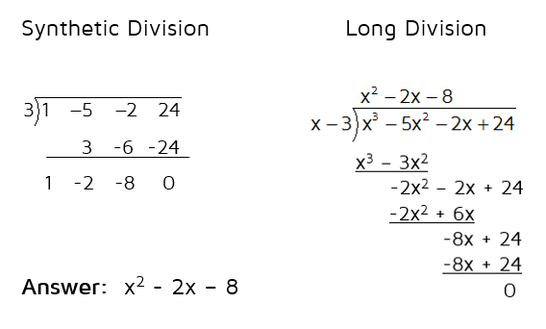
Synthetic Division Kate S Math Lessons
Synthetic division is a shorthand method of dividing polynomials for the special case of dividing by a linear factor whose leading coefficient is 1.
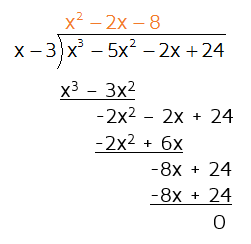
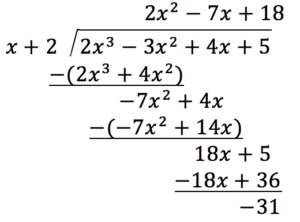
Synthetic division hard problems. As you can see the remainder is 68Since I started with a polynomial of degree 3 and then divided by x 3 that is by a polynomial of degree 1 I am left with a polynomial of degree 2Then the bottom line represents the polynomial 3x 2 7x 24 with a remainder of 68. In this lesson we will look at Synthetic Division which is simplified form of long division. Divide 2x3 3x2 4x5 2 x 3 3 x 2 4 x 5 by x2 x 2 using the long division algorithm.
To set up the problem we need to set the denominator zero to find the number to put in the division box. How to use Synthetic Division to divide polynomials014 When You Can Use Synthetic Division037 Example 1 102 Discussion of Using Zero as a Placeholder for. Then the numerator is written in descending order and if any terms are missing we need to.
Multiply that number you drop by the number in the box. Write the problem out in synthetic division format placing the opposite of the constant in an upside-down division sign. Take the constant term of the divisor with the opposite sign and write it to the left.
Write the coefficients of the dividend to the right. Write the problem in a division-like format. And synthetic division is going to seem like a little bit of voodoo in the context of this video.
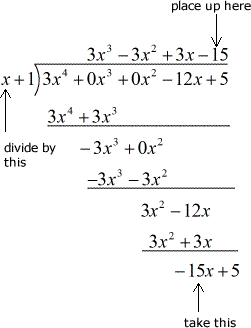
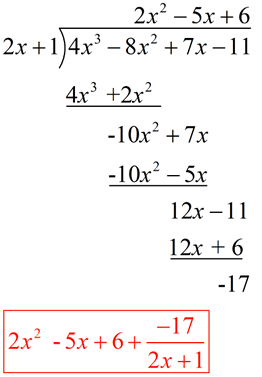
We can simplify the division by detaching the coefficients. Perform the synthetic division. Step Two Write the problem in synthetic division form.
What is Synthetic Division. Correct answers will move you ahead incorrect answers are highlighted in red and require correction before you advance to the next input cell. Synthetic division is a method of dividing polynomials by linear expressions.
And now is a good chance to give it a shot to actually try to simplify this rational. To illustrate the process recall the example at the beginning of the section. Demonstrates synthetic division by showing step-by-step solutions.
The quotient is x 2x - 9 and the remainder is 0. Synthetic division is generally used however not for dividing out factors but for finding zeroes or roots of polynomials. In the next few videos were going to think about why it actually makes sense why you actually get the same result as traditional algebraic long division.
Hit ENTER after each input to move to the next logical cell. Drop the first coefficient below the horizontal line. Next make sure the numerator is written in descending order and if any terms are missing you must use a zero to fill in the missing term finally list only the coefficient in the division problem.
But here its going to be another just lets go through the process of it just so that you get comfortable with it. Complete forms at right to perform your synthetic division. Synthetic division is a shorthand or shortcut method of polynomial division in the special case of dividing by a linear factor -- and it only works in this case.
And in another video we actually have the why this works relative to algebraic long division. Evaluate x 3 8x 3 x 3 using synthetic division. X 3 8x 3 is called the dividend and x.
Bring down the 1 and multiply it. My personal tastes are not to like synthetic division because it is very very very. The height of the solid is x 2x - 9.
Whatever its product place it above the. C 2. To solve for h first divide both sides by 3 x.
C - 2 c 2 inside the box. Find x 4 5 x 3 7 x 2 34 x 1 x 5 using synthetic division. Divide the numbers from step 1 by the opposite of the constant from step 2.
We can now write an equation by substituting the known values into the formula for the volume of a rectangular solid. X 4 x 3 x 2 x 1 x 0 5 1 5 7 34 1. Polynomial Synthetic Division Calculator - apply polynomial synthetic division step-by-step This website uses cookies to ensure you get the best experience.
Synthetic Division is an abbreviated way of dividing a polynomial by a binomial of the form x c or x c. Finally construct a horizontal line just below the coefficients of the dividend. Lets do another synthetic division example.
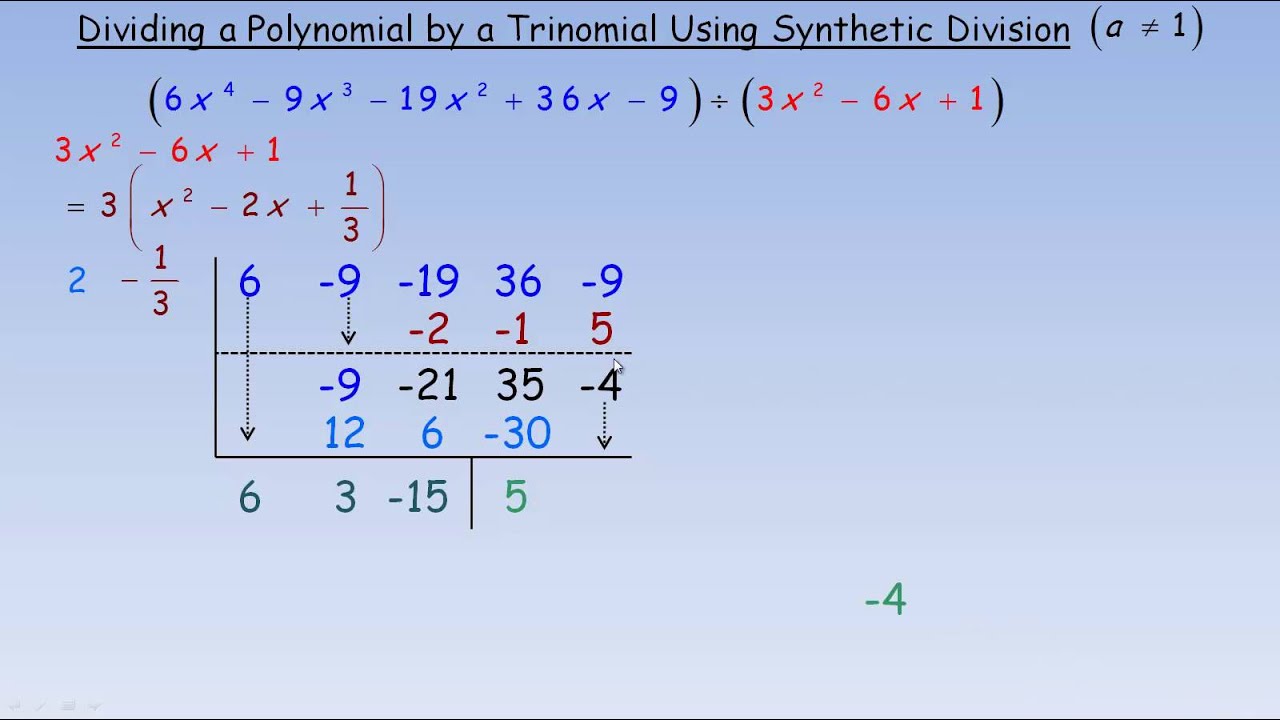
Learn about dividing by synthetic division when the divisor is a fraction. Synthetic division would be more difficult to perform than long division. Find the quotients of the following polynomial division problems using synthetic division.
Critical thinking - apply relevant concepts to examine information about synthetic division in a different light Problem solving - use acquired knowledge to solve practice problems. Now solve for h using synthetic division. 3 1 5 2 28 12.
Following are the steps required for Synthetic Division of a Polynomial.
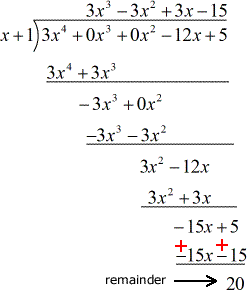
Polynomial Long Division Chilimath
Howto How To Factor Polynomials With 4 Terms Synthetic Division


Dividing Polynomials Ck Foundation Long Division Worksheet Sumnermuseumdc Org
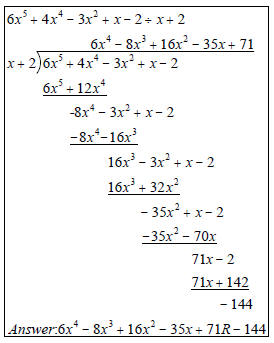
Synthetic Division

Openalgebra Com Dividing Polynomials
Synthetic Division College Algebra

Openalgebra Com Dividing Polynomials
Polynomial Long Division Chilimath

Openalgebra Com Dividing Polynomials

Polynomial Division Brilliant Math Science Wiki
Synthetic Division Kate S Math Lessons
Howto How To Factor Polynomials With 4 Terms Synthetic Division
Howto How To Factor Polynomials With 4 Terms Synthetic Division
Sat Math Multiple Choice Question 266 Answer And Explanation Cracksat Net
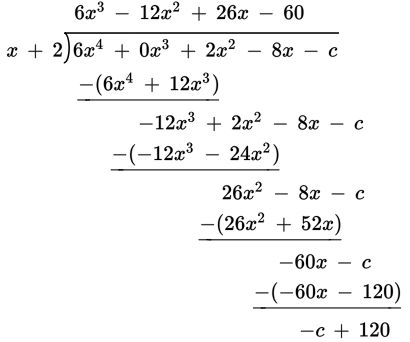
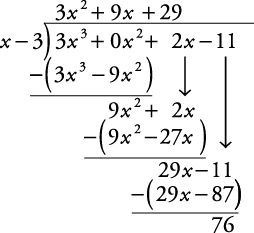
Synthetic Division
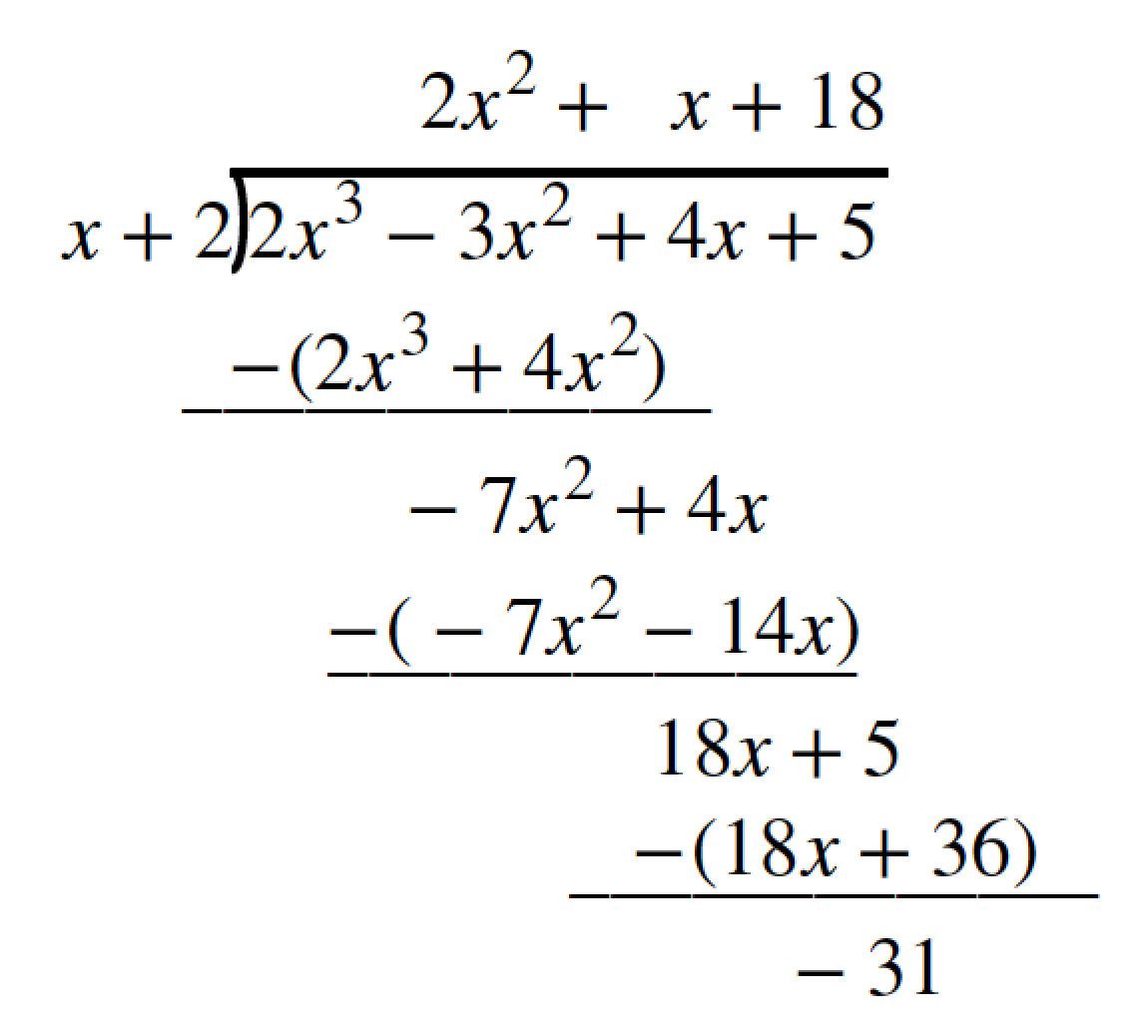
Dividing Polynomials College Algebra
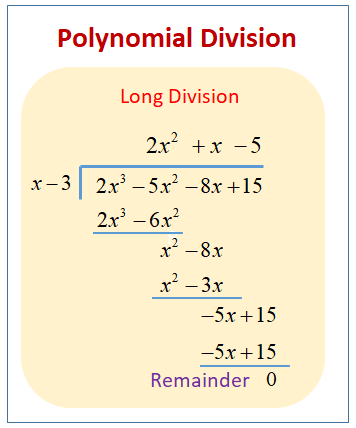
Long Division Of Polynomials Video Lessons Examples And Solutions

Openalgebra Com Dividing Polynomials
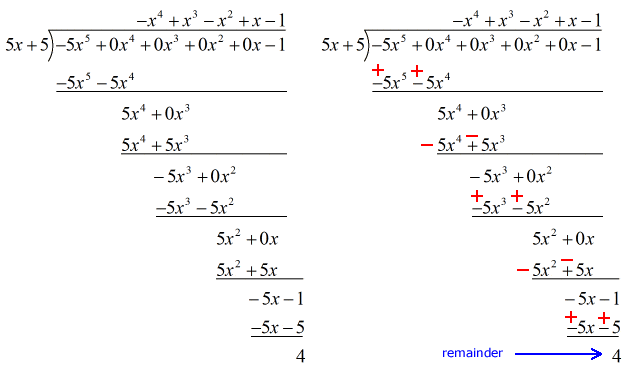
Polynomial Long Division Chilimath